
Inside Dzongu: Why This Restricted Lepcha Reserve is the Most Extraordinary Travel Experience in India
27-05-2026
441
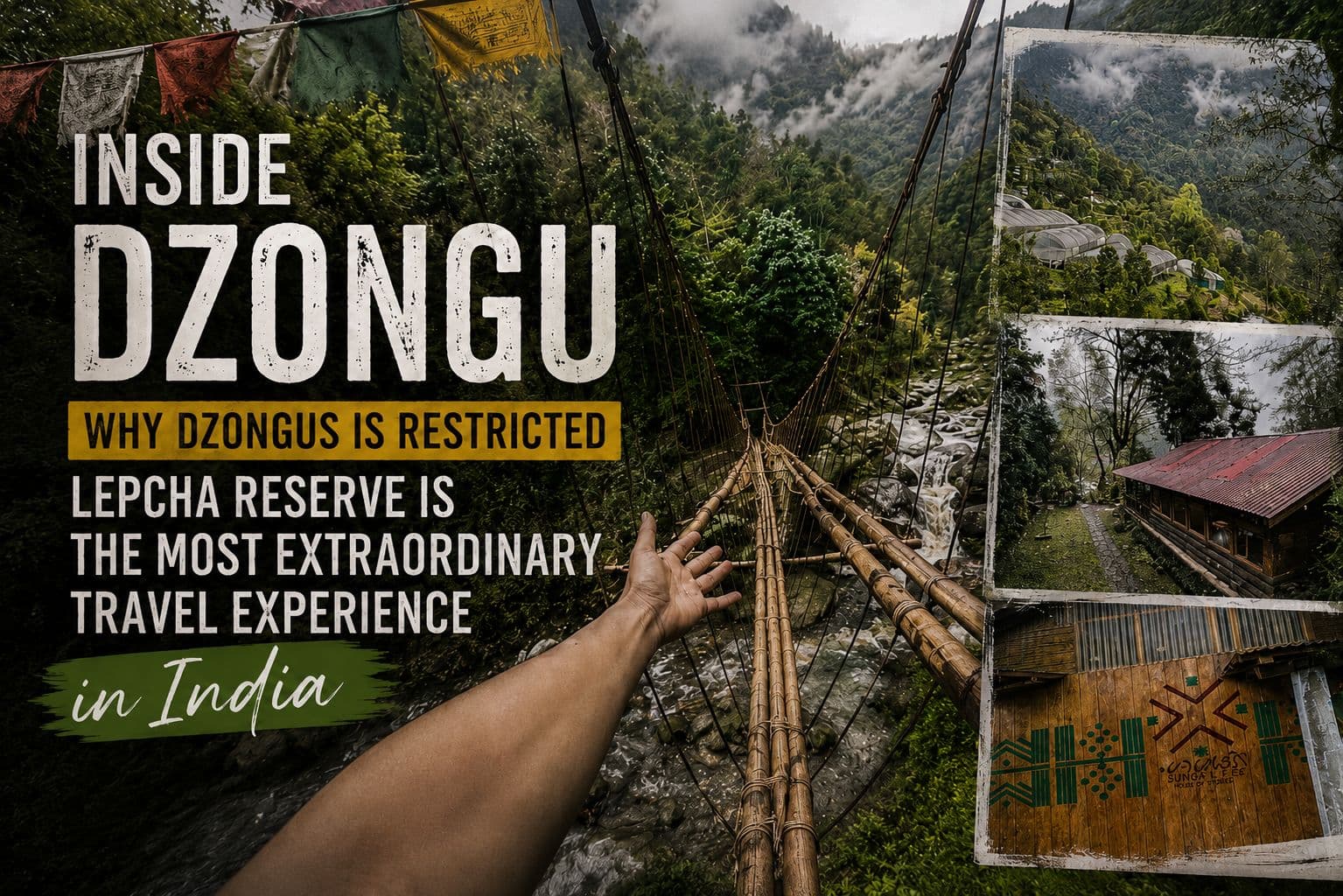
A place so unique, it had to be protected. Welcome to Dzongu — the hidden Lepcha Reserve of North Sikkim.
There are 1.4 billion people in India, and almost none of them have been to Dzongu.
Not because they don't want to. But because they can't — not without permission, not without a guide who knows the families, not without the kind of access that takes years to build. Dzongu is a government-protected Lepcha Reserve in North Sikkim, and it operates on different rules than the rest of the country.
Land here can only be owned by Lepchas. Even Sikkimese citizens need a special permit to enter. Outsiders are admitted in small numbers, for short stays, and only if they've come with the right intentions.
We have been coming here for years. This is what we've learned.
WHO ARE THE LEPCHAS?
The Lepchas are the original inhabitants of Sikkim — perhaps one of the oldest continuous cultures in the Himalayan region. They call themselves Rong, meaning "ravine folk," but are known to others as the Children of the Snowy Peak, because they believe they descend from the glaciers of Mount Kanchenjunga — their mother deity, visible from nearly every hillside in Dzongu.
With a total population of roughly 50,000 scattered across Sikkim, Bhutan, Nepal, and West Bengal, the Lepchas are a small community. In Dzongu, their population is even smaller — around 4,000 people across a network of villages hidden in the forested hills.
Their culture is one of extraordinary intimacy with nature. They have names for hundreds of plants, birds, and insects that Western botany has only recently catalogued. Their traditional knowledge of medicinal plants predates every hospital in the region. Their oral mythology — centered on Mayal Lyang, a hidden paradise from which all Lepchas are said to originate — is a living cosmology, not a historical relic.
In Dzongu, that culture has been preserved. Not in a museum. In the kitchens, the fields, the songs, and the daily rhythms of life.
WHAT IS DZONGU?
Dzongu is a steep, forested, triangular territory in North Sikkim, bordered by the Teesta River to the southeast and the Kanchenjunga range to the west and north. It was declared a protected reserve for the Lepchas in the early 1960s by the rulers of the Sikkim Kingdom — the explicit intention was to preserve Lepcha culture from the diluting effects of mass migration and modernity.
It lies within the buffer zone of the Khangchendzonga Biosphere Reserve — a UNESCO World Heritage Site — which means the biodiversity here is extraordinary. Over 200 species of birds. Red pandas. Himalayan black bears. Wild orchids. Rare medicinal plants. Waterfalls that don't have names because there are too many of them.
The landscape is dramatic in the most unhurried way. Villages appear between cardamom plantations and paddy terraces. Traditional wooden Lepcha homes sit in small gardens full of vegetables and flowers. Prayer flags flutter over forest paths. On clear days, Kanchenjunga looms over everything, enormous and improbable.
WHAT YOU WILL ACTUALLY EXPERIENCE
The experience of Dzongu cannot be summarised in bullet points. But here are some moments that stay with you:
MOMO MAKING IN A LEPCHA KITCHEN
Sitting cross-legged on a wooden floor while your host shows you how to fold the distinctive Lepcha momo pleat. The dough is made from locally milled flour. The filling is churpi — yak cheese — mixed with home-grown vegetables and wild herbs. You eat what you make. Outside, the mountains are doing what mountains do.
A RIVERSIDE PICNIC ON THE TEESTA
The Teesta River is sacred to the Lepchas. On its banks, with freshly made momos still warm, local fruit wines in clay cups, and the sound of water that has been running through these hills since before anyone was counting — this is one of those picnics you will describe to people for years.
FOLK SONG AND DANCE BY FIRELIGHT
On one of your evenings in Dzongu, your host family and their neighbours gather in the courtyard. Someone brings out instruments you've never seen before. The singing begins — ancient, melodic, unhurried — and then the dancing, with footwork that seems to belong to the earth itself. You are not watching a performance. There is no stage. You are sitting in someone's home while they share something precious.
THE FOREST HOT SPRING
Near Lingthem village, there is a natural hot spring in the forest. Sulfur-rich, steaming, surrounded by trees. You soak in it as the forest exhales around you. This is not a spa. It is infinitely better.
BIRDWATCHING AT DAWN
Before the sun rises, you enter the Kanchenjunga Biosphere buffer zone with a Lepcha naturalist who has been watching these birds since he was a child. The forest sounds like an orchestra tuning up. You stop counting species and just listen.
THOLUNG MONASTERY: A JOURNEY INTO LEPCHA SPIRITUAL HISTORY
Reaching Tholung is not simply a visit to a monastery. It is a pilgrimage into the spiritual heart of Dzongu.
Hidden deep within the mountains, Tholung Monastery has stood for centuries as one of North Sikkim’s most sacred Buddhist sites. The journey itself is part of the experience — crossing suspension bridges, following forest trails, and walking through landscapes that feel untouched by time.
Inside the monastery are ancient scriptures, sacred relics, and treasures that have been preserved for generations. Every few years, these relics are displayed during the famous Tholung Monastery festival, drawing pilgrims from across Sikkim.
What stays with you is not just the monastery itself, but the silence around it. Prayer flags flutter in the mountain wind. Monks move quietly through the halls. The forest seems to absorb every sound. It is one of those rare places where spirituality feels woven into the landscape itself.
THE LEPCHA STORYTELLING EVENING
As darkness settles over the village, elders gather around the kitchen fire. Over cups of local millet brew, they share stories passed down through generations — tales of Mount Kanchenjunga, the creation of the Teesta and Rangeet rivers, and the deep relationship between the Lepcha people and nature.
There are no scripts and no performances. Just stories told the way they have always been told, in the warmth of a family home.
CARDAMOM TRAILS AND VILLAGE LIFE
Dzongu’s hillsides are covered with large cardamom plantations, one of the region’s most important crops.
Walk with local farmers through terraced fields and shaded forest paths. Learn how cardamom is grown, harvested, and dried. Along the way, you’ll pass traditional wooden houses, grazing livestock, prayer flags, and children returning from school.
This is not a tourist attraction. It is simply everyday life in Dzongu — and that is exactly what makes it memorable.
SUNRISE OVER KANCHENJUNGA FROM LINGDEM
Before dawn, you climb to a quiet viewpoint above the village. The mountains are hidden in darkness until the first rays of sunlight touch the summit of Kanchenjunga.
Slowly, the world’s third-highest mountain turns gold, then orange, then brilliant white. The valley below begins to wake. Birds call from the forest. Prayer flags stir in the morning breeze.
For a few minutes, it feels as though the entire Himalayan range belongs only to those who woke up early enough to witness it.
FORAGING WITH LOCAL VILLAGERS
The forests around Dzongu are a living pantry for many local families.
Join villagers as they collect wild ferns, mushrooms, medicinal plants, and edible herbs from the forest. Along the way, you learn how generations of Lepchas have lived in harmony with the land, taking only what they need and understanding every plant’s purpose.
By evening, some of what you gathered may appear on your dinner plate.
BEST TIME TO VISIT
October to May offers the clearest skies and the best chance of seeing Kanchenjunga. The post-monsoon months (October–November) are particularly beautiful — the landscape washed clean, the light golden, the air sharp and cool.
June to September is monsoon season. Travel is possible but road conditions can be challenging. The forests are lush and alive with birds, but river crossings require caution.
WHY TRAVEL WITH OFFBEAT SIKKIM
We have been operating in Northeast India for years. Our guides in Dzongu are Lepcha — this is their home. The families you stay with have hosted our guests before. The experiences we offer are real, not staged.
Our experiential 7-Night Lepcha Immersion Journey is currently being curated and will be launched soon. However, customized Dzongu experiences are available throughout the year for travelers who wish to explore this remarkable region in a more personal way.
Whether you're interested in culture, nature, birdwatching, village life, photography, or simply slowing down and connecting with a place deeply, we can design an experience tailored to your interests.
Ready to explore Dzongu?
The Lepcha immersion -7days days in Dzongu - is our most exclusive offering
If you are looking for customize itineraries fill out our enquiry form below, and our team will help create a personalized Dzongu journey for you.
[Book your customize trip with Offbeat Sikkim ]
Some places are visited.
Others are experienced.
Dzongu is meant to be experienced.